
- Teacher: SVI Moodle Administrator
- Teacher: Rajan Thapa
Siddhartha Vanasthali Institute - eLearning
Skip available courses
Available courses
- Teacher: SVI Moodle Administrator
- Teacher: Buddhi Sagar Lamichhane
- Teacher: SVI Moodle Administrator
- Teacher: Richan Shrestha
- Teacher: SVI Moodle Administrator
- Teacher: Bhusan Devkota
- Teacher: Pramod Poudyal
- Teacher: SVI Moodle Administrator
- Teacher: Samjhana Gorkhali
This course provides a comprehensive introduction to the sociological and anthropological foundations of Nepali society and culture, emphasizing their dynamic relationship with business and management. It explores major sociological theories and concepts developed by thinkers such as Emile Durkheim, Karl Marx, Max Weber, George Herbert Mead, and Michel Foucault, while examining key social structures and processes including culture, socialization, gender, kinship, marriage, and social stratification. The course also analyzes issues of caste, ethnicity, class, inequality, and social conflict in the Nepali context, linking them to business ethics, cultural diversity, and management practices. Through critical discussion and applied project work, students will gain the ability to understand and evaluate how social and cultural factors influence business environments in Nepal, enabling them to assess and engage with society more effectively from a business and management perspective.
- Teacher: SVI Moodle Administrator
- Teacher: Ashmita K.C.
- Teacher: SVI Moodle Administrator
- Teacher: Samir Khadka
- Teacher: SVI Moodle Administrator
- Teacher: Sonam Gurung
- Teacher: SVI Moodle Administrator
- Teacher: Parakram KC
- Teacher: Richan Shrestha
- Teacher: SVI Moodle Administrator
- Teacher: Uttam Shrestha
Psychology is a large and rapidly growing field. Psychology is about each of us. Psychology asks "How can we step outside of ourselves for a more objective look at how we live, think and act? The course focuses on the conceptual and methodological frameworks for understanding psychology and its importance in work setting; perception of form and objects and social processes like attribution, attitude, perceptual errors including prejudice and discrimination. Every aspect of behavior is learned behavior. The psychology of learning includes applications of various learning theories on work behavior and vis-a vis work performance. To benefit from learning we must be able to remember them. It is required to know how the human memory works, the reasons behind forgetting and understand the techniques to enhance memory. The course also covers intelligence cognitive and emotional, problem solving behavior, motivation and emotion- factors of subjective wellbeing. Not everyone thinks, feels and acts in the same way, they are not alike. Their personality differs from one another. The course highlights why the people have the personality that they have, how to measure personality, apply in selecting employee to enhance productivity and reduce the workplace deviant behavior (e.g. work place aggression).
- Teacher: SVI Moodle Administrator
- Teacher: Dipesh Upadhyay
- Teacher: Anita Tamang
Upon successful completion of the module, students gain,
-
Proficiency in data handling, including collection, tabulation, and presentation using tools like frequency distributions and graphs.
-
Ability to compute and interpret measures of central tendency (mean, median, mode), dispersion, correlation, and regression for trend prediction.
-
Understanding of hypothesis testing, sampling distributions, and basic forecasting to apply statistical tools in business contexts like aviation operations.
- Teacher: Prajwal Satyal
- Teacher: Sonam Gurung
The course will provide an in-depth understanding of the key concepts and principles of the aviation industry, including its scope, types, and economic and social impacts. They will be able to identify the regulatory bodies and key performance indicators of the industry and analyze the characteristics of passenger airlines and airline profitability. Additionally, they will be able to describe the organizational structure of airlines, including alliances, personnel types, and organizational culture. They will also understand the services provided by airports, including passenger and freight processing, airport security, air navigation services, and air traffic control. Furthermore, they will understand the importance of safety and security in the airline industry, including the role of regulatory agencies, safety culture, issues in air safety, and accident and incident investigation. Finally, students will be able to evaluate the future of the airline industry based on current trends and developments.
- Teacher: Bivechan Khanal
- Teacher: Richan Shrestha
This course provides aviation management students with a comprehensive understanding of meteorological principles and services essential for safe, efficient, and decision-driven aviation operations. Through a structured study of the Earth’s atmosphere, weather elements, aviation weather reports, and significant weather hazards, students will learn to assess and apply weather information in real-world aviation contexts. Emphasis is placed on the weather’s impact on flight safety, airport operations, and operational planning, with special attention to Nepal’s unique orographic and climatic conditions.
- Teacher: Biraj Kandel
- Teacher: Lekh Nath Pokhrel
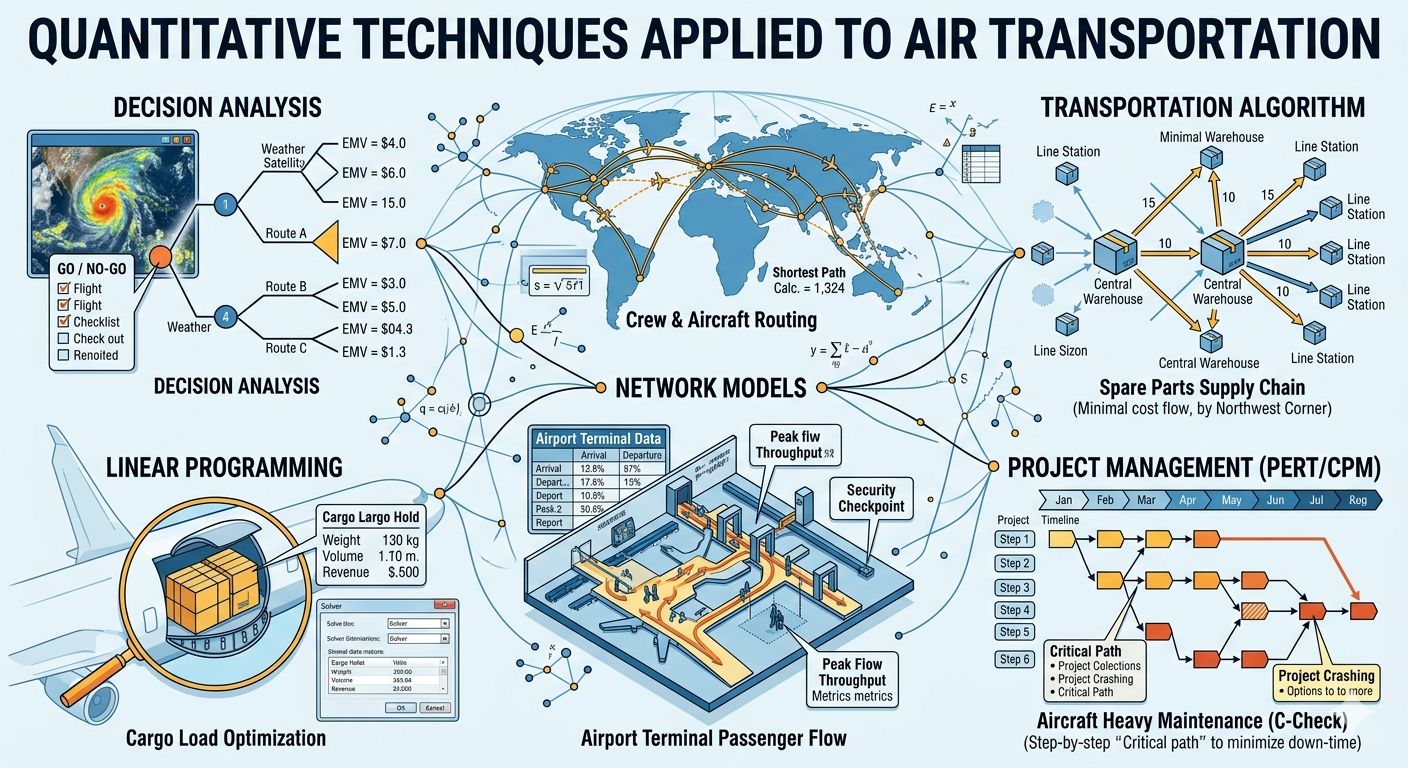
This course is the mathematical engine for future aviation leaders, moving beyond simple arithmetic into the world of Management Science. You will learn to build models that mirror the complex pulse of global air transportation, using a disciplined seven-step approach to solve real-world operational problems.
Through the study of Decision Analysis, Linear Programming, and Game Theory, you will gain the power to optimize everything from cargo revenue and fuel loads to terminal passenger flow and competitive airline pricing. By mastering Network Models and Project Management (PERT/CPM), you will ensure that aircraft maintenance and flight routing are handled with total efficiency.
The Excellence of a Graduate
A student of this course develops a rare "Analytical Instinct," possessing the technical fluency to turn raw data into strategic board-room decisions using MS Excel and POM-QM software. You will possess the unique ability to bridge the gap between technical flight operations and corporate profitability.
Strategic Career Horizons
This quantitative skillset is a "golden ticket" to high-impact roles, including:
1) Revenue & Network Planner: Optimizing flight routes and ticket pricing.
2) Flight Ops & Crew Scheduler: Managing aircraft rotations and crew logistics.
3) Maintenance Project Manager: Leading heavy maintenance (C-Checks) using PERT/CPM.
4) Airport Operations Consultant: Modeling passenger flow and terminal efficiency.
- Teacher: Satish Chaudhary
- Teacher: Bikal Jha
- Teacher: Richan Shrestha
- Teacher: Manish Dewan